
Most marketers struggle to prove AI value to leadership. Only 23% of companies can accurately measure ROI from their AI marketing investments, yet those who do report average returns of 300-500% within 18 months according to Single Grain, 2025.
The gap isn’t capability, it’s methodology. Standard marketing metrics fail to capture the full impact of AI, which creates value across efficiency, performance, and cost avoidance simultaneously. This guide provides a comprehensive framework to calculate AI marketing ROI using three proven methods, helping you move from “guessing” to “proving” value.
Why Traditional ROI Calculations Fail for AI
Standard marketing ROI formulas (Revenue – Cost / Cost) are insufficient for AI initiatives. They were designed for campaigns with linear costs and direct attribution, not for intelligent systems that improve over time and affect multiple operational layers.
AI delivers three simultaneous types of returns that traditional formulas ignore:
- Efficiency gains: Hours saved on repetitive tasks (content, reporting, analysis) that free up capacity.
- Performance lift: Higher conversion rates and revenue from better personalization and targeting.
- Compounding improvements: AI models get smarter with more data, meaning ROI naturally increases over time without additional investment.
To capture the full picture, you need a multi-dimensional approach that tracks hard financial metrics alongside operational efficiency. Ignoring the “soft” benefits of time savings often understates AI ROI by 50% or more.
The Three-Method ROI Calculation Framework
Use the method that matches your current data maturity and implementation stage.
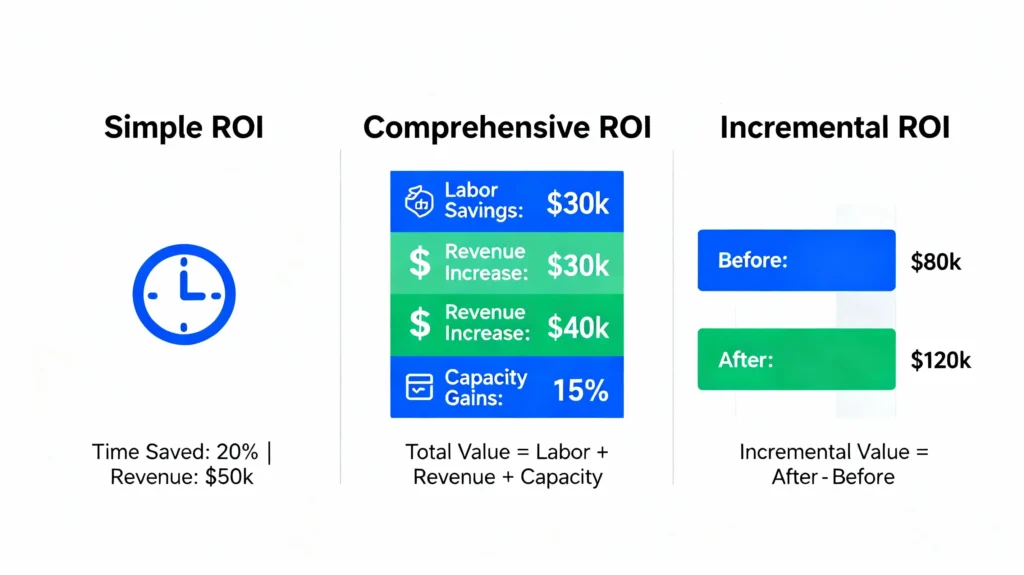
Method 1: Simple ROI (Best for Beginners & Pilots)
This method focuses on direct, easily measurable impacts like time savings and immediate revenue lift. It’s perfect for the first 90 days or single-use-case pilots (e.g., AI content writing).
The Formula:Simple AI ROI=(Time Saved×Hourly Rate)+Direct Revenue Gains−Total AI CostsTotal AI Costs×100%Simple AI ROI=Total AI Costs(Time Saved×Hourly Rate)+Direct Revenue Gains−Total AI Costs×100%
What to measure:
- Time Saved: Weekly hours saved × 52 weeks × average hourly fully-loaded cost.
- Direct Revenue: Incremental sales directly linked to AI campaigns.
- Total Costs: Tool subscriptions + implementation time + training costs.
Real-world example:
A mid-sized agency implements AI for blog content creation.
- Time saved: 12 hours/week × $75/hour × 52 weeks = $46,800
- Direct revenue: $65,000 from new leads via increased content volume
- Total costs: $25,000 (tools + staff training)
- ROI = ($46,800 + $65,000 – $25,000) / $25,000 × 100% = 347%
Method 2: Comprehensive ROI (Best for Scaling Teams)
This method captures the full economic value across efficiency, revenue, and strategic capabilities. It requires more sophisticated tracking but provides the accurate long-term view needed for annual planning.
The Formula:Comprehensive ROI=Total Value Created−Total InvestmentTotal Investment×100%Comprehensive ROI=Total InvestmentTotal Value Created−Total Investment×100%
Where Total Value Created includes:
- Labor cost savings: Efficiency gains monetized.
- Incremental revenue: Performance lift across all AI-touched channels.
- Cost avoidance: Agency fees saved, reduced error rates, lower ad waste.
- Customer retention value: Revenue protected through churn prediction.
Strategic application: Use this for board reporting and budget defense. It demonstrates how AI transforms the P&L, not just campaign metrics.
Method 3: Incremental ROI (Best for Optimization)
This method isolates AI’s specific contribution by comparing performance against control groups. It answers the critical question: “What results came specifically from AI versus what would have happened anyway?”
The Formula:Incremental ROI=(AI Results−Baseline Results)×Value per Result−AI CostsAI Costs×100%Incremental ROI=AI Costs(AI Results−Baseline Results)×Value per Result−AI Costs×100%
Implementation:
Run an A/B test where 50% of traffic gets AI personalization and 50% gets standard static content. Calculate the revenue difference (lift) and subtract the AI tool cost.
Ideal use case: Testing new tools (e.g., AI vs. manual email subject lines) to decide whether to renew a subscription.
Essential KPIs to Track
ROI is a lagging indicator. You need leading indicators to predict success and spot issues early. Track these three categories weekly:
1. Efficiency Metrics (Operational Impact)
- Time savings per task: Measure hours saved on specific workflows (e.g., “newsletter creation time”). Target: 40-60% reduction.
- Cost per production unit: The fully-loaded cost to produce one asset (blog post, video, campaign). Target: 30-50% decrease.
- Automation rate: Percentage of routine tasks handled by AI without human intervention. Target: 50%+ within 12 months.
2. Revenue Impact Metrics (Financial Performance)
- Conversion rate lift: Improvement in AI-optimized landing pages or emails vs. baseline. Target: 15-25% lift.
- Customer Acquisition Cost (CAC): Reduction in ad spend or labor required to acquire a customer. Target: 10-20% reduction.
- Average Order Value (AOV): Increase driven by AI product recommendations. Target: 5-15% increase.
3. AI Performance Metrics (System Health)
- Model accuracy: For predictive AI (lead scoring, churn), how often is the prediction correct? Target: 80%+ accuracy.
- Content quality score: Human-rated quality of AI-generated outputs (1-10 scale). Target: Score > 8/10.
- Usage/Adoption rate: Percentage of team members actively using the tools. Target: 100% adoption within 90 days.
ROI Benchmarks by Implementation Stage
Setting realistic expectations is critical. AI ROI follows a J-curve—initial costs are high, but returns compound exponentially.
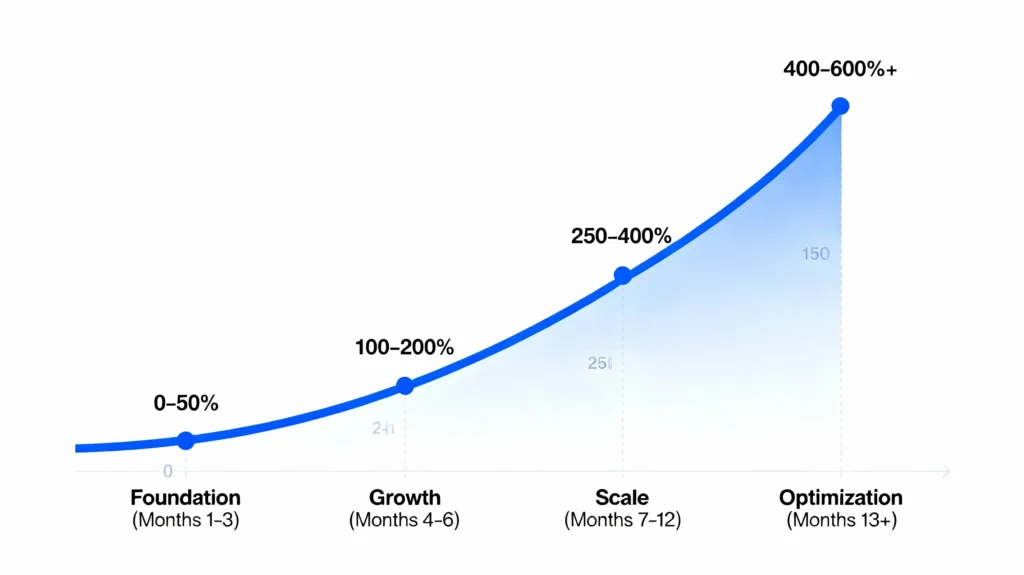
- Months 1-3 (Foundation): ROI 0-50%
Focus is on setup, training, and data cleaning. You are investing, not harvesting. Efficiency gains start to appear, but revenue impact is minimal. Don’t pull the plug early. - Months 4-6 (Growth): ROI 100-200%
Efficiency gains compound. Quick wins in content velocity and email open rates appear. Initial pilots prove value. You should be breaking even or better. - Months 7-12 (Scale): ROI 250-400%
Revenue impact overtakes efficiency gains. Multiple use cases are active (ads + content + email). Personalization starts driving measurable sales lift. - Months 13+ (Optimization): ROI 400%+
Mature implementation. AI models are fine-tuned on your data. Continuous improvement loops are established. Competitive advantage becomes visible in margins.
Common ROI Calculation Mistakes to Avoid
1. Ignoring fully-loaded implementation costs
Most teams only count the software subscription fee. You must include:
- Implementation time (internal hours)
- Training costs (courses, workshops)
- Integration fees (consultants, API costs)
- Management overhead
Mistake impact: Overstates ROI by 50-100%.
2. Double-counting revenue
If an AI tool writes the email subject line, you can’t attribute 100% of the sales from that email to AI. The offer, product, and landing page also played a role.
Solution: Use incremental lift (Method 3) or conservative attribution (e.g., attribute 20% of lift to AI).
3. Measuring too early
Calculating ROI in week 2 will almost always show a loss due to setup time and learning curves. This demoralizes the team.
Solution: Set a 90-day minimum window before formal financial ROI reporting.
4. Failing to monetize time savings
“We saved 10 hours” is a vanity metric unless you monetize it. Did those 10 hours go into strategy? Did they allow you to avoid hiring a freelancer?
Solution: Always multiply hours saved by the fully-loaded hourly cost to show dollar value.
Your Measurement Action Plan
Day 1: Establish your baselines. Record current time-per-task, CAC, and conversion rates. You cannot measure lift without a baseline.
Day 7: Select your calculation method. Start with Method 1 (Simple ROI) for your pilot projects.
Day 30: Run your first “Time Saved” audit. Survey the team to quantify efficiency gains and identify bottlenecks.
Day 90: Calculate full ROI using Method 2 and present to leadership. Include both hard financial numbers and efficiency stories.
Ready to optimize your strategy? Use our 90-Day AI Marketing Plan to ensure your implementation delivers maximum returns from day one, and select the right AI marketing framework to align these metrics with your broader business goals.