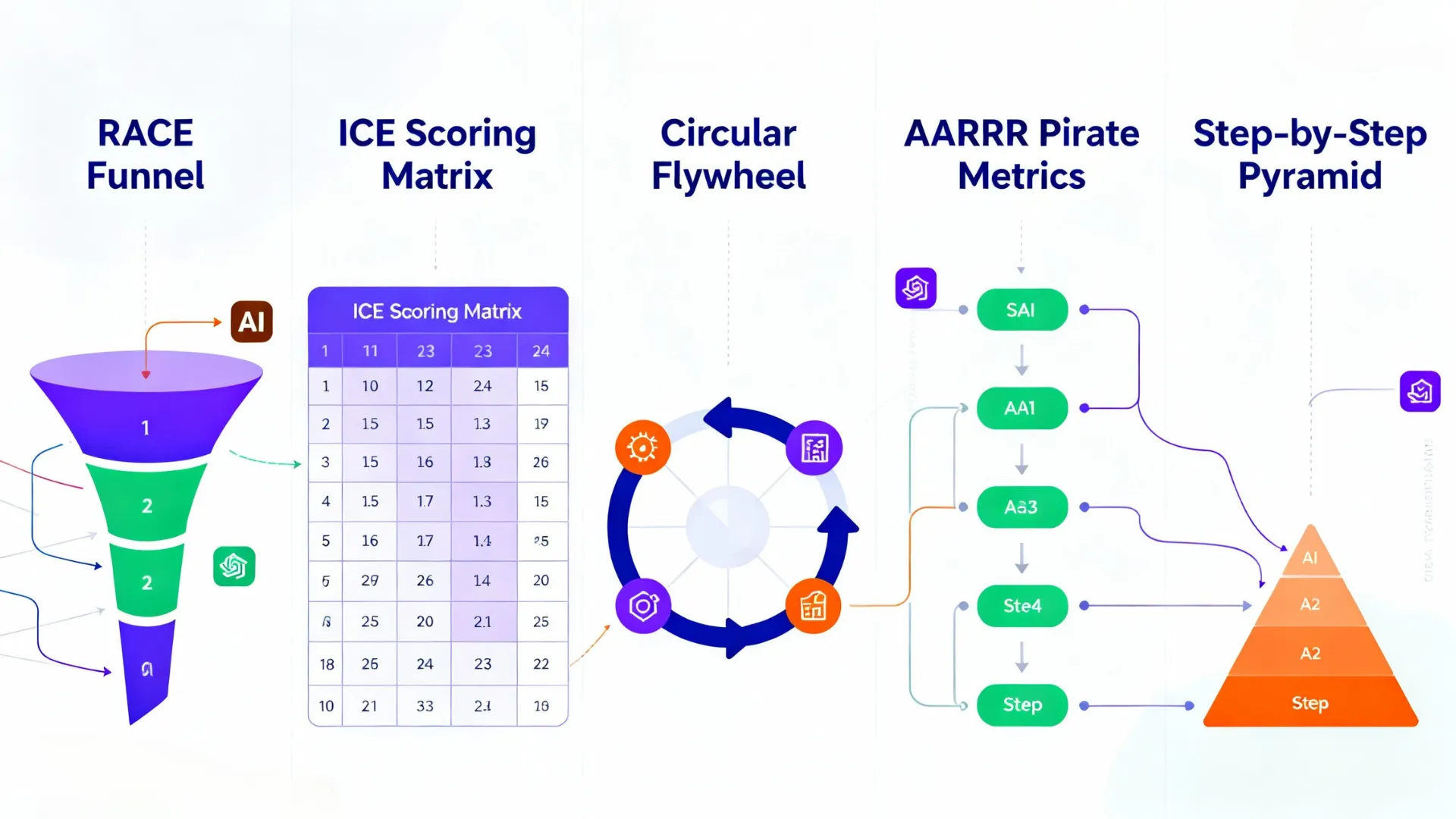
Choosing the right framework is the difference between scattered AI experiments and a cohesive marketing strategy. Companies using structured AI frameworks are 2.5x more likely to achieve ROI within 12 months according to McKinsey, 2024. Yet 68% of marketers still deploy AI tools without strategic frameworks, leading to wasted budgets and minimal impact.
This guide compares five battle-tested AI marketing frameworks designed for different business contexts. You’ll discover which framework matches your industry, company size, and marketing maturity level—plus get actionable implementation templates for each model.
Why AI Marketing Frameworks Matter
Frameworks provide the strategic scaffolding that transforms AI tools into business results. Without them, teams chase shiny objects, duplicate efforts, and struggle to measure impact. With them, every AI initiative connects to clear objectives, measurable KPIs, and continuous optimization loops.
The right framework aligns three critical elements: your business goals, customer journey stages, and AI capabilities. It answers what to automate, when to personalize, and how to measure success at each touchpoint.
Framework selection depends on four factors:
- Your primary marketing objective (awareness, conversion, retention, growth)
- Industry characteristics (B2B vs B2C, transaction vs subscription)
- Team size and technical capabilities
- Current marketing maturity and data infrastructure
Framework 1: RACE AI (Reach, Act, Convert, Engage)
Best for: E-commerce brands, content marketers, and multi-channel campaigns focused on full-funnel optimization.
The RACE framework maps AI applications to four customer journey stages. Originally developed by Smart Insights for digital marketing, the AI adaptation layers machine learning capabilities onto each phase.
Reach phase deploys AI for audience discovery and targeting. Use predictive analytics to identify high-value segments, lookalike modeling to expand reach, and AI-powered SEO tools to optimize content discoverability. Tools like SEMrush AI and Clearscope excel here.
Act phase focuses on engagement optimization. AI personalizes landing pages, optimizes email send times, and A/B tests messaging variations at scale. Platforms like Optimizely and Dynamic Yield power this stage.
Convert phase leverages AI for lead scoring, dynamic pricing, and conversion rate optimization. Machine learning identifies friction points, predicts purchase intent, and serves personalized offers. HubSpot AI and Salesforce Einstein are leaders.
Engage phase uses AI for retention and loyalty. Predictive churn models, automated nurture sequences, and personalized recommendations keep customers active. Klaviyo and Braze dominate this category.
Implementation timeline: 8-12 weeks to deploy across all four stages with measurable KPIs at each phase.
Framework 2: ICE Score AI (Impact, Confidence, Ease)
Best for: Resource-constrained teams, startups, and agile marketing operations that need rapid prioritization.
The ICE framework prioritizes AI initiatives based on three dimensions scored 1-10. This prevents teams from tackling complex, low-impact projects while ignoring quick wins.
Impact score measures potential business results. An AI chatbot handling 50% of support queries scores 8-9. An AI tool that improves subject lines marginally scores 3-4.
Confidence score rates your certainty of success. If similar companies achieved documented results, score 8-10. If it’s experimental with limited proof, score 3-5.
Ease score evaluates implementation complexity. No-code tools requiring 2 weeks score 8-10. Custom development needing 6 months scores 2-4.
Calculate total ICE score by averaging all three dimensions. Prioritize projects scoring 7+ first. These deliver maximum ROI with minimum risk.
Sample ICE scoring:
- Email send-time optimization: Impact 7, Confidence 9, Ease 9 = ICE 8.3 (Do first)
- Custom predictive analytics model: Impact 9, Confidence 6, Ease 3 = ICE 6.0 (Do later)
- AI social media scheduling: Impact 5, Confidence 8, Ease 8 = ICE 7.0 (Quick win)
This framework shines for quarterly planning cycles. Score 10-15 potential AI projects, then tackle the top 3-4 each quarter based on ICE rankings.
Framework 3: Marketing Flywheel AI (Attract, Engage, Delight)
Best for: B2B SaaS, service businesses, and companies prioritizing customer lifetime value over one-time transactions.
The flywheel framework focuses on momentum and compounding returns. Unlike linear funnels, it recognizes that delighted customers fuel growth through referrals and expansion revenue. AI accelerates each phase.
Attract phase uses AI-powered content intelligence to identify high-intent topics, optimize SEO at scale, and target ideal customer profiles across paid channels. Tools like MarketMuse and 6sense excel here.
Engage phase deploys conversational AI, personalized demo experiences, and intelligent lead routing to convert prospects efficiently. Drift, Intercom, and Qualified power this stage.
Delight phase leverages AI for proactive support, predictive success management, and personalized upsell recommendations. Gainsight and ChurnZero lead this category.
The critical difference: Each phase feeds the next with data and momentum. Delighted customers create social proof that attracts better prospects. Better prospects engage more deeply. Deeper engagement creates more delighted customers.
AI amplifies the flywheel effect by: analyzing success patterns across thousands of customers, predicting which actions drive satisfaction, and automatically scaling winning strategies. The result is exponential rather than linear growth.
Implementation focus: Start with one phase where pain is greatest, then expand systematically to capture full flywheel momentum.
Framework 4: AARRR AI (Acquisition, Activation, Retention, Revenue, Referral)
Best for: Growth-stage startups, mobile apps, and PLG (product-led growth) companies obsessed with metrics and experimentation.
The pirate metrics framework (AARRR) maps AI to five critical growth levers. Each stage has specific KPIs and AI applications designed for optimization.
Acquisition focuses on AI-optimized paid ads, predictive audience targeting, and conversion rate optimization. Meta Advantage+ and Google Performance Max automate this entirely.
Activation uses AI to personalize onboarding, predict feature adoption, and identify early success indicators. Pendo and Appcues power intelligent activation flows.
Retention deploys predictive churn models, automated re-engagement campaigns, and personalized push notifications. Amplitude and Mixpanel provide behavioral analytics and AI insights.
Revenue leverages dynamic pricing, intelligent upsell prompting, and payment optimization. Stripe Revenue Recognition and ProfitWell use AI to maximize monetization.
Referral applies AI to identify likely advocates, optimize referral program messaging, and predict viral coefficient improvements. Viral Loops and ReferralCandy offer AI-enhanced capabilities.
The framework’s power lies in cohort analysis. Track how AI improvements in one stage impact downstream metrics. A 10% activation improvement might drive 30% revenue gains due to compounding effects.
Measurement cadence: Review AARRR metrics weekly, run AI optimization experiments bi-weekly, and report cohort improvements monthly to stakeholders.
Framework 5: Scalzon AI Marketing Framework (Diagnose, Deploy, Measure, Scale)
Best for: Marketing teams new to AI seeking a structured, risk-minimized implementation approach with built-in learning loops.
The Scalzon framework emphasizes systematic experimentation over big-bang deployments. It’s designed specifically for marketers without technical backgrounds who need guardrails and clear success criteria.
Diagnose phase involves AI readiness assessment across five dimensions: data infrastructure (quality and accessibility), team capabilities (skills and mindsets), technology stack (integration readiness), budget allocation (realistic expectations), and strategic clarity (defined objectives and KPIs).
Deploy phase follows the pilot-optimize-scale progression. Start with one high-impact, low-complexity use case. Run for 30-60 days with clear success metrics. Gather learnings systematically. Only scale after proving ROI.
Measure phase tracks both leading indicators (AI model performance, data quality, user adoption) and lagging indicators (revenue impact, cost savings, customer satisfaction). This dual focus catches problems early while proving business value.
Scale phase expands successful pilots across channels, markets, or customer segments. It also layers additional AI capabilities onto proven foundations, creating compounding improvements.
The framework includes built-in checkpoints: Every 30 days, teams review performance, document learnings, and decide whether to continue, pivot, or stop each AI initiative. This prevents zombie projects that consume resources without delivering results.
Unique advantage: The Scalzon framework explicitly addresses change management and skill development. Each phase includes team training, stakeholder communication templates, and cross-functional collaboration protocols.
Framework Comparison: Which Fits Your Business?
| Framework | Best For | Complexity | Timeline | Primary Focus |
|---|---|---|---|---|
| RACE AI | E-commerce, multi-channel | Medium | 8-12 weeks | Full-funnel optimization |
| ICE Score AI | Startups, limited resources | Low | 2-4 weeks | Rapid prioritization |
| Flywheel AI | B2B SaaS, services | Medium-High | 12-16 weeks | Customer lifetime value |
| AARRR AI | Growth-stage, PLG companies | High | 16-20 weeks | Metrics-driven growth |
| Scalzon AI | AI beginners, risk-averse teams | Low-Medium | 4-8 weeks | Systematic experimentation |
Selection criteria by business stage:
- Pre-revenue/MVP: Use ICE Score AI to maximize limited resources
- Early traction: Deploy Scalzon AI for safe, structured learning
- Growth stage: Implement AARRR AI for aggressive scaling
- Mature business: Choose RACE AI or Flywheel AI based on B2C vs B2B model
Industry-specific recommendations:
- E-commerce: RACE AI captures full customer journey
- B2B SaaS: Flywheel AI emphasizes retention and expansion
- Mobile apps: AARRR AI aligns with product-led growth metrics
- Local services: Scalzon AI provides structured approach without complexity
- Enterprise B2B: Flywheel AI + Account-Based Marketing layer
Implementation: Your First 30 Days
Week 1: Framework selection and team alignment. Review all five frameworks with marketing leadership. Score each against your business context using these criteria: strategic fit (1-10), resource availability (1-10), technical readiness (1-10). Select the highest-scoring option.
Week 2: Map current state to framework. Document which AI tools you already use and where they fit in your chosen framework. Identify gaps between current capabilities and framework requirements.
Week 3: Prioritize initial AI initiatives. Using your framework’s prioritization logic (ICE scores for ICE framework, stage analysis for RACE/AARRR), identify 3-5 high-impact opportunities.
Week 4: Build implementation roadmap. Create a 90-day plan showing which AI capabilities deploy when, required resources, success metrics, and key milestones. Present to stakeholders for approval and resource allocation.
The most common mistake: Trying to implement all framework stages simultaneously. Successful deployments focus on 1-2 stages first, prove value, then expand systematically.
Adapting Frameworks as You Scale
No framework is set-and-forget. Your AI marketing approach must evolve as your business grows and market conditions shift.
Quarterly framework reviews assess three questions: Are we measuring the right KPIs? Do our AI tools still address priority use cases? Has our business model changed enough to warrant a different framework?
Many mature organizations use hybrid approaches. RACE AI for customer journey mapping combined with ICE scoring for project prioritization. AARRR metrics feeding into Flywheel optimization strategies.
The framework serves you—not the reverse. If a specific stage or element doesn’t fit your context, modify it. The structure matters more than rigid adherence to any particular model.
Start with one framework, implement it thoroughly, and refine based on results. Strategic consistency beats framework perfection every time. The companies winning with AI marketing aren’t using secret frameworks—they’re executing proven frameworks with discipline and continuous improvement.