
Most AI marketing initiatives fail within 60 days. Only 1% of organizations achieve mature AI rollouts despite 78% attempting it, according to Averi AI, 2025. The difference isn’t technology—it’s execution.
Rushing deployment leads to poor results, while dragging it out kills momentum. A structured 90-day timeline is the “sweet spot” to prove ROI and build sustainable habits. This guide transforms you from novice to AI practitioner through three structured phases: Foundation, Integration, and Scale.
🛠️ Pre-Launch: Week Zero Checklist
Invest 3-5 days before Day 1 to build your foundation. Skipping this leads to “tool fatigue” by Week 3.
Secure Sponsorship
Schedule a 30-minute sync with leadership. Present this roadmap and request a “pilot budget” for 90 days.
✅ Success criteria: Written budget approval.
Audit Your Data
Check your data sources: clean email lists, blog archives for AI training, CRM completeness.
✅ Success criteria: Data readiness score above 80%.
Select One Tool
Don’t buy 10 tools. Pick one platform (HubSpot AI, Jasper, or ChatGPT Plus) based on your main pain point.
✅ Success criteria: Account created and integrated.
Define Your KPIs
Record current baselines: time per blog post, email open rates, ad CTR. No baseline = no ROI proof.
✅ Success criteria: Baseline metrics document created.
🚀 Phase 1: Foundation (Days 1-30)
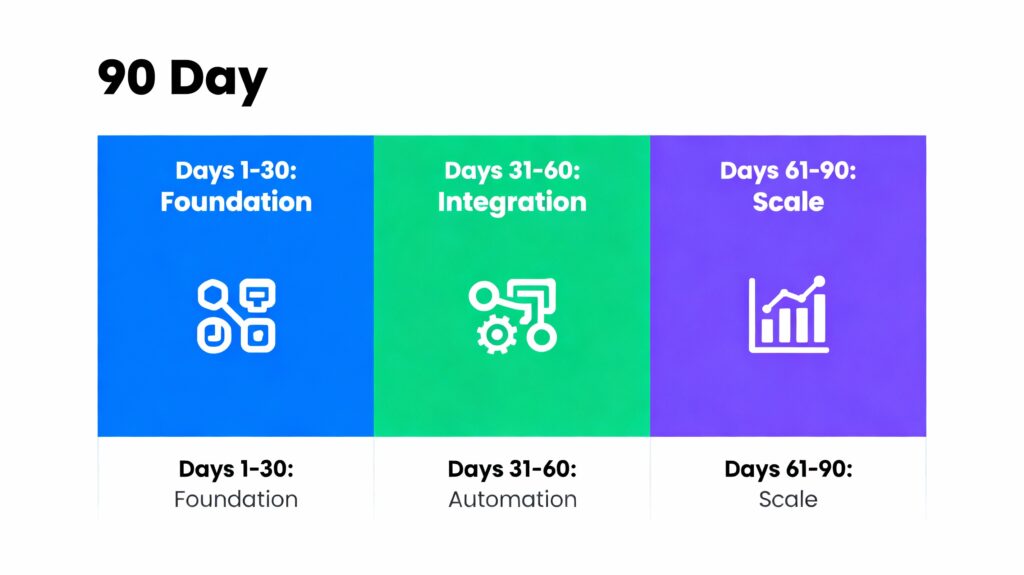
Goal: Establish baseline capabilities, prove quick wins, and build team confidence.
Success Metrics:
- 20% time reduction on selected tasks
- 1 functioning AI use case
- Team confidence score above 6/10
📅 Week 1-2: Setup & Quick Wins
Focus on high-impact, low-risk tasks that save immediate time.
Days 1-3: Tool Onboarding
Upload 5 examples of your best content (blogs, emails) to “teach” the AI your tone. Save this as a system prompt or brand voice guide.
- Train AI on your specific vocabulary
- Define tone (formal, friendly, expert)
- List words/phrases to avoid
- Deliverable: Brand Voice Guide v1.0
Days 4-7: First Pilot
Generate 5 blog outlines or 10 social posts. Do not aim for perfection—measure time saved versus manual work.
- Start with simple tasks (outlines, brainstorming)
- Track time spent vs. previous manual method
- Document quality observations
- Deliverable: First AI-assisted campaign live
Days 8-10: Hybrid Writing
Implement the “Sandwich Method” for optimal results:
- Human Outline (10% of time)
- AI Draft (80% of time)
- Human Edit (10% of time)
- Deliverable: Content velocity report showing 2x speed improvement
Days 11-14: Repurposing Workflow
Build a prompt chain to multiply your content output:
- 1 blog post → 3 LinkedIn posts
- 1 blog post → 1 newsletter blurb
- 1 blog post → 5 tweets/X posts
- Deliverable: Repurposing workflow active and documented
💡 Pro Tip: Start with creation tasks (drafting, brainstorming) rather than strategy tasks. Quick wins build team confidence faster.
📅 Week 3-4: Automation & Review
Move from manual prompting to semi-automated workflows.
Days 15-21: Email Workflow
Draft a 3-part welcome sequence using AI personalization variables:
- Personalize by industry or job role
- Use dynamic fields: “As a [Job Title], you likely struggle with [Pain Point]”
- A/B test AI subject lines vs. human-written
- Deliverable: Automated welcome series live
Days 22-27: Social Scheduling
Use AI to optimize your posting strategy:
- Analyze past performance data
- Predict optimal posting times
- Schedule 2 weeks of content in one sitting
- Deliverable: Social calendar filled for 14 days
Days 28-30: Month 1 Review
Compile results and prepare stakeholder communication:
- Survey the team: “What task improved most?”
- Analyze quality scores (1-10 rating)
- Calculate preliminary time savings
- Deliverable: Phase 1 Impact Report for leadership
⚡ Phase 2: Integration (Days 31-60)
Goal: Deepen capabilities and integrate AI across marketing functions.
Success Metrics:
- 40% reduction in manual tasks
- 3 integrated workflows active
- Positive ROI on tool costs
📅 Week 5-6: Advanced Content & Customer Journey
Expand beyond simple text generation to strategic applications.
Days 31-37: Complex Formats
Tackle higher-value content types:
- SEO keyword clustering (group hundreds of keywords by intent)
- Long-form guides (2,000+ words) with AI structure
- Video scripts from existing blog posts
- Deliverable: SEO Keyword Strategy document
Days 38-44: Lead Scoring
Move beyond basic engagement metrics:
- Weight behavioral signals (pricing page visits, demo requests)
- Score high-intent actions higher than email opens
- Connect AI scoring to your CRM
- Deliverable: AI Lead Scoring Model active in CRM
💡 Pro Tip: Connect your AI content tool directly to your CMS (WordPress/HubSpot) to eliminate copy-paste friction and save 30 minutes per article.
📅 Week 7-8: Paid Media & Mid-Point Assessment
Apply AI to performance marketing and validate financial impact.
Days 45-51: Ad Creative Testing
Scale your creative testing with AI:
- Generate 20 headline variations for top-performing ads
- Test top 5 against your control
- Use AI to suggest lookalike audience criteria
- Deliverable: Ad Performance Report showing CTR improvement
Days 52-60: Mid-Point ROI Audit
Calculate and present your progress:
- Use the Simple ROI Method (Time Saved × Hourly Cost + Revenue Gains – Tool Costs)
- Document wins and obstacles
- Request budget expansion if ROI > 0%
- Deliverable: Phase 2 ROI Calculation presented to leadership
📈 Phase 3: Scale & Optimize (Days 61-90)
Goal: Expand organization-wide and establish Centers of Excellence.
Success Metrics:
- 60% efficiency gain
- 200-400% ROI documented
- Center of Excellence established
📅 Week 9-10: Prediction & Team Training
Shift from creation to prediction and democratize knowledge.
Days 61-67: Predictive Analytics
Move from reactive to proactive marketing:
- Forecast next month’s campaign performance
- Identify “at-risk” customers for churn prevention
- Predict content topics likely to perform well
- Deliverable: Churn Prediction Dashboard
Days 68-74: Team Expansion
Scale AI knowledge across the organization:
- Create an “AI Playbook” with tested prompts
- Train “AI Champions” in Sales and Customer Success
- Document common mistakes and solutions
- Deliverable: Internal AI Training Workshop completed
📅 Week 11-12: Quality Optimization & Future Planning
Refine outputs and plan for long-term sustainability.
Days 75-81: Quality Audit
Prevent AI drift and maintain standards:
- Review content quality scores over time
- Retrain brand voice models with latest best-performing content
- Update prompt templates based on learnings
- Deliverable: Quality Assurance Report
Days 82-90: Future Roadmap
Plan your next phase of growth:
- Identify one new tool to test (e.g., AI Video)
- Set goals for Days 91-180
- Present final report with “Before vs. After” metrics
- Deliverable: Executive Presentation Deck with ROI summary
📊 Measuring Success: Weekly KPIs
Track these three metrics weekly to stay on course:
Efficiency: Time Savings
Hours saved × Hourly cost
🎯 Target by Day 90: 6-12 hours/week/person
Velocity: Output Volume
Content pieces produced per week
🎯 Target by Day 90: 2-3x increase from baseline
Performance: Conversion Lift
Change in engagement or conversion rate
🎯 Target by Day 90: +15-25% lift
🛑 Common Pitfalls to Avoid
Starting Too Broad
Don’t AI-ify everything at once. Stick to the roadmap phases. Focus creates momentum.
Skipping Brand Training
If you don’t train AI on your brand voice in Week 1, content will sound generic forever. Invest the 2 hours upfront.
Ignoring the Human Loop
AI is a co-pilot, not autopilot. Always edit before publishing to avoid hallucinations and maintain credibility.
Ready to start Day 1?
Select your AI marketing framework first to ensure this 90-day plan aligns with your broader business strategy.